

Apr 16, 2026 - In response to the State Board of Elections (SBE) March 18 decision to reject my petition, asking them to enact a rule requiring some personally identifying information (PII) from in-person voters who opt to sign an affidavit instead of showing a photo ID.
As I explained in an earlier post (click here), any absentee voter who uses that form, called a “Photo ID Exception Form,” only has to write their name and address on the signed form and check a block beside an excuse for not showing a photo ID, in order to vote.
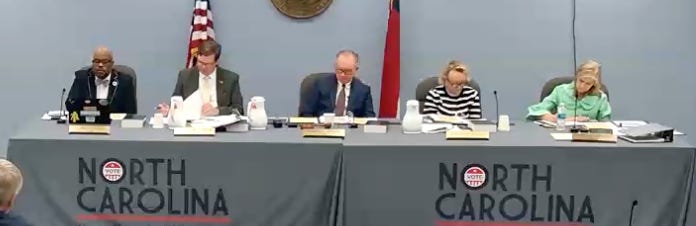
At that meeting, the SBE voted 5-0 to reject my petition, asserting that it was “outside of the State Board’s rulemaking authority and would instead be a process that could only be implemented by our legislature.”
I disagreed with their ruling and filed an appeal, asking the Lee County Superior Court to remand the case back to the SBE, because of the phrase in subsection (e) of this law, directing the SBE to create the form that required certain fields of information, “at a minimum.”
My actual petition to Superior Court was based on the SBE’s misinterpretation of the law. In order for them to be right, “at a minimum” really means “at a maximum,” and they cannot add more items to the form without going back to the Legislature.
In effect, the statute seems written to set a floor… but the SBE viewed it as a ceiling.
Before You Ask
I’ll close this post with some Questions and Answers we’ve wargamed for those seeking more depth to this issue:
Q: What is this case about?
This case turns on whether “at a minimum” means the Board has discretion to add to the form or is limited to only what’s listed.
---
Q: Aren’t you asking to add a new requirement for voters?
No, this addresses verification of an affidavit, not voter eligibility.
---
Q: Why didn’t the legislature include this requirement if it wanted it?
Because the statute sets minimum contents and delegates the rest of the form’s design to the Board.
---
Q: Isn’t this a policy question for the Board?
The Board could have made a policy choice, but it instead concluded it had no authority, which is a legal error.
---
Q: What about a voter who doesn’t know their DL number or SSN?
That voter can use the provisional ballot process under subsection (c), which remains fully intact. Subsection (c) requires the voter to bring their photo ID to the County Board of Election before the canvass, in order to have their vote count.
---
Q: Doesn’t this conflict with the statutory scheme?
No, it fits within it by working alongside subsection (c) as the fallback mechanism.
---
Q: Aren’t forms different from rules?
Even if the form itself is not a rule, the statute requires the Board to adopt it and leaves its contents to the Board’s discretion.
---
Q: Why is this not outside the Board’s authority?
Because the statute expressly directs the Board to adopt the form and defines only its minimum contents.
---
Q: What is the Board’s actual error?
It treated a statutory floor as a ceiling and concluded it lacked authority to act at all.
---
Q: What standard of review applies?
This is a question of statutory interpretation reviewed de novo.
---
Q: What relief are you asking for?
A remand so the Board can reconsider the petition under a correct understanding of its authority.
---
Q: Are you asking the Court to adopt your rule?
No, only that the Board be allowed to exercise its authority under the correct legal standard.
---
Q: Why should the Court care about this?
Because it determines whether the Board must follow the statute as written when exercising delegated authority.
---
Q: Can the Board ever add anything beyond the statute?
Yes, where the statute sets minimum requirements, the Board may add reasonable elements consistent with its delegated authority.
---
Q: What’s your strongest point?
The statute says “at a minimum,” and the Board treated it as a maximum—that’s the error.
Cheers!
~jd