

March 20, 2026 — Note: I would love to have gotten this posted sooner, but life truly has the right-of-way.
The plan was to elaborate on Wednesday’s disappointing dismissal of my modest election security suggestion to the NC State Board of Elections (SBE), but it turned out to be only the undercard in an event featuring some heavy weight issues, oh and Senator Phil Berger’s desperate election protests also came up!
So there’s that.
The three topics in today’s post will cover 1) how the SBE is proposing to handle the anticipated influx of non-citizen voters coming in after the SAVE-America Act get’s passed, 2) my modest proposal for enhanced election integrity, and 3) how the Board swatted down any discussion of Sen. Berger’s gasps of agony last breaths in his sunken efforts to claw back his stunning 23-vote defeat.
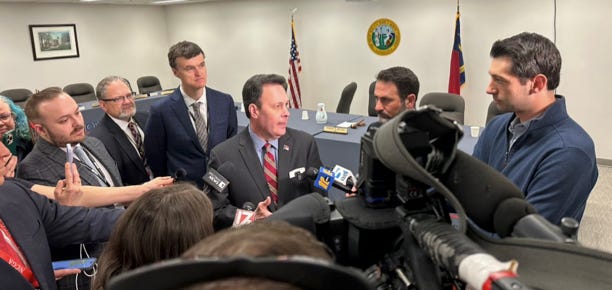
This was no ordinary meeting for the State Board of Elections. The room was packed. I had no idea why, but was pretty sure it had nothing to do with my petition. After asking around, I got the answer from a very nice, but very very wrong, leftist influencer named Annie. She identifies as “just a pediatrician,” but she refused to give me her last name and later was spotted handing out doughnuts to some on her team.
SAVE Lite
Paraphrasing Annie, the Screeching Left had been triggered by a proposed set of agency rules that will guide future SBE’s in how to deal with any non-citizens found to have been voting in our elections. Their evident rallying cry was that the rules were “SAVE Lite.”
The rules are pretty straightforward, but never perfect. During a 60-day public comment period, citizens concerned with election integrity provided feedback on some of the things they didn’t like and the total number of comments hovered around 2,000. But about a week ago, something changed and people started flooding the comment portal with another 15,000 comments. (You can peruse them by clicking here.) According to one official, many of the comments were “copy and pasted with the exact same message” and a lot of them criticized the SAVE Act instead of the proposed rules.
The comment period ended Monday night at 11:59 PM, and the “final approval” vote was scheduled for Wednesday’s 10 AM meeting.
The SBE’s problem was a pesky little law that mandates, “prior to adoption, an agency must . . . consider any public comments received in connection with the proposed rule.”
Doing the math, their schedule meant the SBE staff would have had to “consider” 17,000 comments in a 34-hour period, forcing them to read and ponder nearly 13 comments per second for 34 hours. I suppose A.I. could have made light work of it, but this was going to be a problem.
You can no longer comment on them, but if you want to see the proposed rules, who am I to stop you?! First was the terms and definitions, linked here. The second section (linked here) directs the affected voter’s county board of elections (CBE) to file notice of due process within five days of their being notified. The CBE has to schedule a “voter challenge hearing” and gives the voter time to bring certain types of evidence that would prove their US citizenship. The third rule (linked here) lays out how the challenged voter’s preliminary hearing will be conducted and the fourth rule (linked here) delineates how the actual challenge hearing is to be conducted.
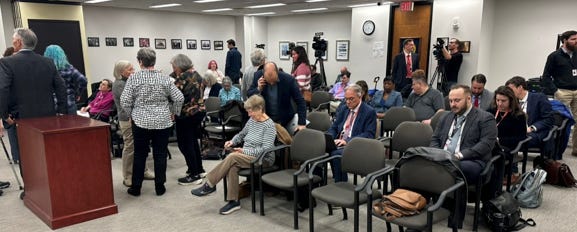
Once the Board understood the enormity of the last-minute public comments and the staff’s challenge in absorbing all of the complaints, they voted to postpone the approval process.
My latest pitch for honest elections
Anytime an otherwise-intelligent person arrogantly claims that NC has a “strict voter ID law,” I guffaw as loudly as possible. It’s an absurd statement. Far from “strict,” I’ve regularly called it the most fraud-friendly voter ID law in America and my petition to the Board was a constructive suggestion on how to tighten up security without disenfranchising anybody.
In the interest of brevity, I’ll avoid reciting all the reasons our voter ID law is a joke, and just point you here for my earlier rant on the subject and move on to how I was hoping to mitigate the most idiotic aspect of that silly law.
At issue was a last-minute addition to an already weak voter ID bill. Caving to pressure, the legislature added a provision allowing anybody to vote without providing a photo ID, as long as they can fill out a piece of paper in a way that isn’t an obvious lie. The document, called a “Photo ID Exception Form,” requires the voter to check a block beside legal excuses for why don’t have a photo ID.1 And if none of those excuses seem suitable, they can make up a new one.
Under “Other,” boards are supposed to allow any reason that’s not an obvious lie. some boards have even accepted “I didn’t know ID was required” as a valid excuse! As I write these words, I’m a sitting county board member, and I’d be shocked if I could muster a majority vote to reject a exception form that claimed, “the dog ate my ID card.” It looks like a lie, but we’re not allowed to make the voter prove it.
No kidding! Check out some of the laughable excuses our fake-ID law allows:
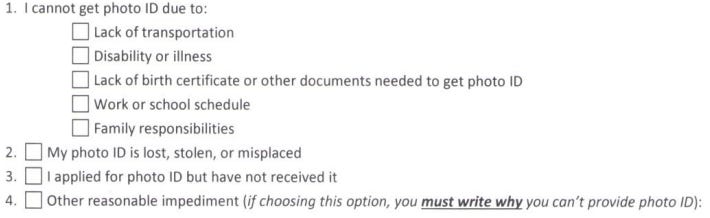
Imagine the plight of somebody whose work schedule for their entire life was so busy that they couldn’t bother with getting the kind of ID that would allow them to check into a hotel room, board an airplane, visit a federal building, or apply for college. Would you have a hard time believing them?
Or how about the poor homeless person who was too mentally incompetent to carry any identity documents on his person. Instead of helping that person rejoin society by getting them some help, what kind of human being would only focus on dragging this person to the polls to vote?
The friendly leftist debate opponents, I met last Wednesday, were quick to mention “studies” claiming minorities are “less likely” to be capable of obtaining such ID. But reality paints a different picture. Since the idea of photo-voter ID came into discussion, the well-funded Left has filed numerous federal lawsuits intended to weaken them at every turn. Through sheer exhaustion, the defendants, legislative leaders, governors, and people on election boards, usually wind up settling the suit by agreeing to weaken their proposed law.
Rinse and Repeat
Once the judge signs off on the new, weaker security guidelines, other states adopt the weaker standards in hopes of not getting sued. In NC and beyond, that trick never works. The Left sues anyway. With any luck, they’ll get an Obama- or Biden-appointed federal judge, who will cooperate with the Plaintiffs to demand more compromises to the Defendant’s election integrity law. And it almost always works.
The plaintiffs use academic fluff, peer-reviewed papers, claiming the large-scale existence of such persons who will not be able to vote because of voter ID laws. Harkening back the the Democrats’ good-ol’ days, they even call it a “poll tax.”
But here’s the dirty little secret: Studies is all they have. Despite their best efforts, the Left has never—in the history of voter ID lawsuits—never been able to find one of those persons in reality and bring to the trial. Not a single witness has survived cross examination in the history of federal litigation over this issue. Let that sink in.
Never…
Despite this reality, North Carolina politicians gleefully patted themselves on the back when they surrendered in advance of the inevitable lawsuit, by adding the Exception Form. Trying to con their supporters, they assured their less-aware voters that they had to do it, “in order to avoid getting sued.”
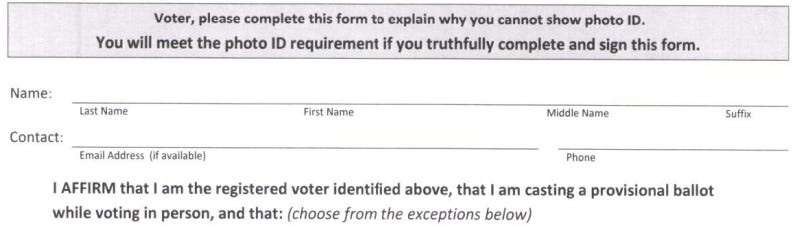
Making the parody even more comical is that in-person voters who use this loophole to avoid showing an ID, don’t even have to provide any personally identifying information (called “PII”) that might help confirm their identity.
In my petition, I mistakenly said the walk-in voters have to provide their date of birth. Only after I submitted it, did I realize the mistake. Here’s a shot of all the non-ID voter has to supply in order to have their excuse accepted:
When originally passed, I and not enough others sounded the alarm. The Legislature had gutted their own voter ID law before the Left could fire a single shot. Republican outrage grew so high that the bill sponsor published a tut-tut editorial, calming everybody down by claiming the provision was in force for a recent South Carolina election, and only 18 people used the provision.
My problem is never with how many people have used it. If we learned anything from 2020, we saw how the Left exploited the lax security measures cooked into the nation’s absentee voting laws. So they design in some loopholes that are fully scalable. And then they wait. When the time is right, ten thousand voters can walk in and all claim a exemption for showing an ID… and the law will require their votes to be counted.
The Fix
Of course, a stricter federal law would reset the entire game board, but we’re not there yet and Democrats would rather eat a bucket of used auto parts than permit such common sense come out of Washington.
Until that day of honest elections finally comes, the states have to devise their own patches to our bad federal laws. But even then, blue states might will disobey.
In a lawfully administered voter registration system, a 2004 federal law requires all registered voters to provide their driver’s license number in order to register to vote. If—and only if—they were never issued a driver’s license, they were allowed to provide the last four of their Social Security number (called SSN-4).
For more than a decade, but both Democrat and “Republican” election officials were caught breaking that federal law. It took citizen action to draw the attention of Trump 2.0 Department of Justice, and they filed a recent lawsuit against the state. As part of the settlement, our SBE started correcting around 500,000 non-compliant registrations. They didn’t fix them all yet, but they have made a start at it.
The reason I took you down that rabbit trail was because absentee voters use a different Photo ID Exception Form different than the in-person voters’ form in one significant way.
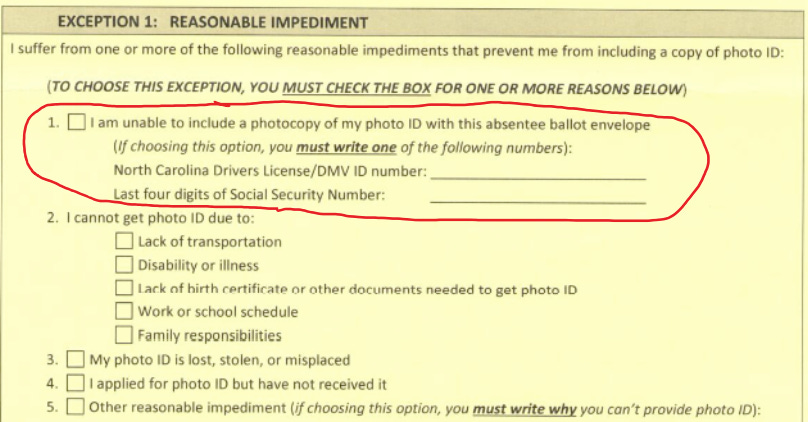
For those listening to this Substack, the form requires applicants to provide either their NCDL# or their SSN-4 as part of the process. If the numbers don’t match, election officials must try to contact the voter and obtain the corrected information. Failing that, CBEs can2 reject the ballot over the voter providing false information.
My proposal was to require PII from the in-person voters who use an excuse to avoid providing a valid photo ID.
The problem with my suggestion came down to timing. Remember how the Legislature’s leaders at the time, Senator Phil Berger and House Speaker Tim Moore, had included the “reasonable impediment” loophole in their voter ID law? It didn’t work.
Never satisfied with any safeguards to our election, the Soros-backed Left sued us anyway!
That lawsuit is still pending, so election officials and legislators are are deer in the headlights when it comes to patching any obvious loopholes in our current voter ID laws.
So in the official record (linked here) my petition was shot down because it’s “outside of the State Board’s rulemaking authority and would instead be a process that could only be implemented by our legislature.”
The giant nothing Berger
This post has gotten too long and I have to travel today, so I’ll cut to the punchline on this last topic.
Unless you were out on an ayahuasca retreat since election day, you’ve heard that Senate Leader Phil Berger isn’t taking his 23-vote defeat like a man. In fact, besides his demand for a recount, his legal team thrashed like a drowning swimmer, coughing out four different election protests while trying to scratch and claw his way back into power. Not a good look.
Responding to Berger’s recount request, the state re-issued guidance on how the law directs the entire recount process. It’s pretty detailed, so I’ll just link it here.
Probably the biggest reason all of the media jokers were interested in Wednesday’s SBE meeting was to see what they were going to do about Berger’s flailing efforts. Instead, of holding lengthy discussions on the matter, the Board patiently listened to staff attorney Adam Steele as he explained the afore mentioned guidance. And since the process has not yet played out, the Board need take no further action.
After a pregnant pause, Chairman Francis DeLuca asked if there was a motion to adjourn. And just like that, both the media and the Senator’s droop-dog legal team walked away with nothing.
If you like learning more about how elections are really being administered in NC and what you can do about it, please become a free or paid subscriber. If anything big happens, I usually start by commenting about it on the platform formerly known as “Twitter” (@VoteChecker), but if it’s really important, you might even see me breaking it all down in another Substack.
So… fear not! Go out. Enjoy life! Touch grass and have yourselves a wonderful Spring weekend!
~ jd
Several lefties I met Wednesday all pointed to the fact that Reasonable Impediment votes are “provisional ballots,” but their eyes glazed over when I tried to explain how they are just provisional in name only. This is because the last sentence in subsection (f) of the governing statute says, “the county board of elections shall find that the provisional ballot is valid unless the county board has grounds to believe the affidavit is false.” When you go back and re-read the allowed excuses, the Board has no way of verifying any of the excuses and the ballots are counted, 99.9% of the time.
I say “can,” because some don’t. In 2024, two CBEs violated state law and voted to allow certain ballots cast by dead voters to count! One CBE voted 3-2 along Democrat majority party lines. In another county, only one Republican opposed the measure. I reported on this earlier, but their rogue behavior shows how CBEs have too much latitude in accepting provisional ballots.